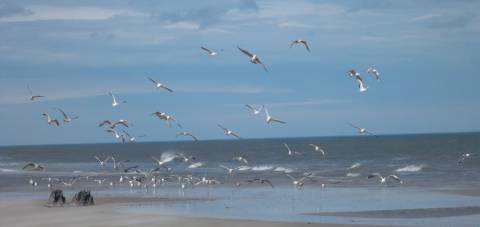
![Shorebirds over the surf at the water's edge on Carova Beach, NC]()
Low tide: the easiest time to drive
Around low tide the water pulls back and exposes hard-packed sand along the ocean. That's the smoothest, fastest lane on the beach, and it's where most drivers head when they can. When you have a choice, plan arrival-day drives, grocery runs and trips to Corolla for the hours around low tide.
One exception: from the Friday before Memorial Day through Labor Day, vehicles must use the driving lanes along the dune line between mileposts 14.5 and 17 from 9 a.m. to 5 p.m., whatever the tide.
High tide: what to expect
At high tide the ocean covers the firm sand, and traffic moves up into the softer ruts closer to the dunes. It's still drivable in a true 4x4 with aired-down tires, just slower.
- Pick a set of ruts and keep a steady speed rather than stopping.
- If an oncoming car is in your ruts, signal and ease over at a shallow angle, not straight across.
- If you start to bog down, don't keep spinning your tires. Stop, back out and try again. Our Driving on Sand guide has more on getting unstuck.
Tides and parking on the beach
Park in the middle of the beach so other cars can pass on both sides, and keep chairs, coolers and fishing lines out of the driving lanes. As the tide comes in you may need to move your car and gear. Everything has to be off the beach by sunset, when the whole beach becomes a driving lane. See Carova parking and permits for permit rules.
When the forecast isn't the whole story
Tide charts are predictions. Strong onshore winds, storms and the higher tides around full and new moons can push water higher than forecast and narrow the beach further. If it looks tight, wait for the tide to turn rather than squeezing past the water's edge.
Staying with us? Plan your arrival around the tide and browse our Carova Beach rentals.